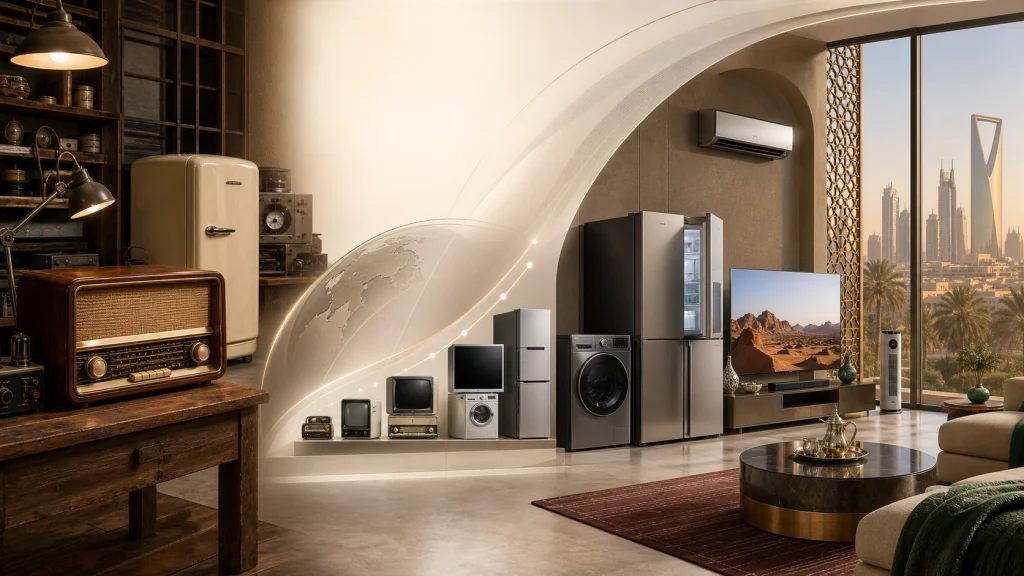
LG’s electronics story began with Goldstar in 1958, at a time when South Korea was building its industrial capabilities. The business became LG Electronics in 1995—the same year its air-conditioning partnership with Shaker Group began in Saudi Arabia.
In this guide (15)
- Early Roots: From Chemicals to Electronics
- How Goldstar Became LG
- Going Global Required More Than Good Products
- When Did LG Enter the Saudi Market?
- Why a Local Partnership Mattered
- From Importing Products to Local Manufacturing
- Building an Official Saudi Operation
- How LG Adapted to Saudi Customers
- A Presence Beyond the Home
- What LG’s Saudi Journey Teaches Us
- How to Shop for LG Products More Intelligently
- A Practical Pre-Purchase Checklist
- LG’s Future in Saudi Arabia
- Conclusion
- Official Sources
The active LG code on Coboniksa is SJAL9 (10% off). Enter it in the coupon box at checkout and confirm the change in the order total before you pay.
| Store | Code | Offer | Link |
|---|---|---|---|
| LG | SJAL9 | 10% off | Store page |
Walk into a modern home in Saudi Arabia and there is a good chance that you will find an LG television, refrigerator, washing machine or air conditioner. The brand now feels like a familiar part of the Kingdom’s consumer-electronics market, yet its global position was built over decades. Its story began in South Korea during a period of industrial reconstruction, when manufacturing a locally designed radio was a major national achievement.
This article follows LG from its earliest industrial roots to its development into a global technology company. It then looks closely at how LG built a presence in Saudi Arabia—not simply by shipping products into the country, but through local partnership, manufacturing, service infrastructure and solutions adapted to the Kingdom’s climate and customers.
Early Roots: From Chemicals to Electronics
The corporate roots of the wider group go back to Lucky Chemical, founded in South Korea in 1947. The business produced chemical and consumer goods at a time when the country was trying to develop domestic industry. As demand for locally manufactured electrical products grew, Goldstar was established in 1958. That company would eventually become LG Electronics.
According to LG’s official company history, Goldstar was Korea’s first electronics company. It produced the country’s first locally made radio in 1959 and its first refrigerator in 1965. These were more than commercial launches. They demonstrated that Korean industry could move from dependence on imports toward product development and manufacturing.
Goldstar focused on technology connected to everyday life: radios, televisions, refrigerators, washing machines and air conditioners. That early focus shaped a lasting part of the company’s identity. Technology was presented not as an abstract achievement, but as a practical way to make homes more comfortable and daily tasks easier.
How Goldstar Became LG
As the group expanded and its businesses became more diverse, the Lucky-Goldstar name came into use during the 1980s. In 1995, the company formally adopted the name LG Electronics. The change was not just a shorter label. It represented a new phase in which the business wanted a global identity that could be pronounced and remembered across many languages.
The “Life’s Good” idea later became central to the brand. LG says the phrase appeared in Australia in the late 1990s and was adopted globally in 2003. It connected technology with the experience it was meant to create, a theme that later extended into product design, customer service and connected-home platforms.
Going Global Required More Than Good Products
Entering a new country requires more than manufacturing a reliable appliance. Markets differ in climate, housing, electrical infrastructure, regulation, retail practices and customer expectations. A company must also answer practical questions about delivery, installation, warranty, spare parts and repair service.
LG’s international growth therefore relied on a combination of research and development, distributors, local partnerships, service networks and regional production. Its product range also expanded from basic household appliances into advanced displays, air solutions, commercial systems, components and connected devices.
That strategy helps explain the company’s position in the Gulf. Saudi buyers do not judge a product only by a global specification sheet. They also consider whether it can withstand extreme heat and dust, how efficiently it uses electricity, whether trained technicians and spare parts are available, and whether the model fits local homes and usage patterns.
When Did LG Enter the Saudi Market?
LG’s Saudi story is better understood as a sequence of stages rather than a single store-opening date. LG’s recent official corporate reporting says that its air-conditioning partnership with Shaker Group began in 1995. The two companies then established a joint venture in 2006, supporting the expansion of both consumer and business operations in the Kingdom.
Another official LG article celebrating three decades of cooperation describes a partnership focused on heating, ventilation and air-conditioning solutions tailored to Saudi Arabia and the wider Middle East. This shows why the local relationship became more than a sales channel: it developed into a platform for manufacturing, technical expertise and access to major projects.
Some summaries associate 2008 with the manufacturing facility. That date can be understood as a later operating or expansion stage, while LG’s newer corporate source identifies 2006 as the year the joint venture was formed. A careful history therefore separates the partnership launched in 1995, the joint venture created in 2006 and the operational milestones that followed.
Why a Local Partnership Mattered
Saudi Arabia is geographically large, and its climate creates demanding conditions for cooling equipment. Seasonal demand can also be significant, requiring inventory, distribution, installation and maintenance across multiple cities. A capable local partner gives an international manufacturer market knowledge, retail access, service capacity and familiarity with local standards.
For LG, Shaker Group became particularly important in air conditioning. The terms of LG’s official Saudi online store direct support for air conditioners and air purifiers to Shaker Group, while LG Electronics Saudi Arabia handles support for home appliances and home entertainment categories. This division of responsibility reveals how a mature local presence is built through specialized roles rather than a brand name alone.
From Importing Products to Local Manufacturing
A strong sign of long-term commitment is the ability to produce and develop solutions within a region. LG says it has a production base in Saudi Arabia. The company also reports that air-conditioning outdoor units developed for the region use heat exchangers engineered to withstand sandstorms and high temperatures, with production at the local LG–Shaker facility.
This matters because climate equipment cannot be evaluated in the same way as a television or a small appliance. In Saudi Arabia, an air conditioner may run for long hours during extremely hot months while exposed to dust, sand and heavy cooling loads. Real-world performance, energy efficiency, serviceability and durability become central purchasing factors.
In 2025, LG announced discussions with King Saud University, Pusan National University and Shaker Group about establishing a Saudi test facility for HVAC solutions used in hot climates. The stated goal is to gather field data and assess reliability and efficiency. This signals a shift from selling globally designed products to participating in research intended for regional conditions.
Building an Official Saudi Operation
Today, LG operates locally through LG Electronics Saudi Arabia LLC, a company incorporated under Saudi law with a registered office in Jeddah. It also runs an official Saudi online store and provides support channels for customers inside the Kingdom.
The current local portfolio includes televisions, refrigerators, washing machines, monitors, home-entertainment products and air solutions, as well as systems for businesses and large projects. This breadth reduces dependence on any single category and enables the brand to serve homes, hospitality, offices, commercial facilities and digital infrastructure.
How LG Adapted to Saudi Customers
International brand recognition helps, but it does not guarantee long-term success. LG’s Saudi development can be understood through several connected forms of localization:
- Cooling systems designed for heat, dust and energy-efficiency requirements.
- Arabic and English sales and customer-support channels.
- Distribution, installation and maintenance capabilities developed with a Saudi partner.
- Local warranty and after-sales support.
- Product ranges suitable for apartments, large homes and commercial projects.
- E-commerce options alongside established physical retail channels.
Energy efficiency has become especially important because the purchase price is only one part of an appliance’s cost. An air conditioner or refrigerator may operate for many years, and differences in electricity use and maintenance can become more valuable than a small saving at checkout. Smart buying therefore considers the total cost of ownership.
A Presence Beyond the Home
LG’s Saudi business is not limited to products sold directly to consumers. The company is expanding in business and project solutions, including central cooling, thermal management and commercial displays. Recent official announcements describe involvement in smart-infrastructure initiatives, including collaboration connected to cooling solutions for an AI data center planned for Oxagon in NEOM.
This expansion reflects LG’s broader ambition to become a “Smart Life Solution Company.” In the home, that can mean connected devices and simpler control. In business environments, it can mean integrated systems, centralized management, energy performance and long-term technical services.
What LG’s Saudi Journey Teaches Us
The company’s experience offers useful lessons for any global brand entering Saudi Arabia. First, moving the same product from one market to another is rarely enough; products and services must be adapted to climate, behavior and regulation. Second, a strong local partnership can shorten the learning curve and build trust. Third, after-sales service is part of the product itself, especially for large appliances.
The story also shows the value of continuity. A partnership launched in 1995 developed over decades into local manufacturing, commercial solutions and climate-related research. These accumulated capabilities create a market presence that cannot be reproduced quickly through advertising alone.
How to Shop for LG Products More Intelligently
Before buying any appliance, define the real requirement. For a television, compare display technology, size and viewing distance. For a refrigerator, match internal capacity with the physical dimensions of the kitchen. For a washing machine, check load capacity, programs and water and energy consumption. For an air conditioner, do not choose capacity by floor area alone; insulation, sunlight, ceiling height and windows affect the cooling load.
Next, compare price, warranty, installation and delivery as one package. A lower advertised price can be less attractive if installation is excluded or the seller does not provide an authorized warranty. Always check the complete model number, because visually similar products may differ in features, production year or energy performance.
You can review available products or promotions through this current offer link and compare them with LG’s official Saudi store and authorized retailers before buying. This is an affiliate link, and CoboniKsa may receive a commission if you complete a purchase through it, at no additional cost to you.
A Practical Pre-Purchase Checklist
- Confirm that the complete model number matches the specification you researched.
- Read the warranty terms and identify who will provide repairs.
- Check delivery, installation and upper-floor handling charges.
- Review the energy-efficiency label and expected running cost.
- Compare the final price after any coupon or promotion, not only the headline price.
- Keep the invoice, serial number and photos of the product at delivery.
- Review the return process for damage or incorrect specifications.
If you are buying several appliances for one home, compare a complete bundle with the price of each item separately. A bundle may include combined delivery or an extra discount, but calculating each component prevents an inflated item from hiding inside the package.
LG’s Future in Saudi Arabia
Recent developments suggest that LG’s next phase in the Kingdom will combine smart homes, energy efficiency and business solutions. Local climate testing, cooperation with universities and participation in major infrastructure initiatives indicate a willingness to develop for the region rather than simply market standard global models.
Software and artificial intelligence will likely play a larger role in how appliances operate, but the most useful innovation will continue to produce practical outcomes: lower energy consumption, longer service life, easier maintenance and greater comfort. The word “smart” should not justify a purchase unless the feature adds value that can be used regularly.
Conclusion
LG’s electronics story began with Goldstar in 1958, at a time when South Korea was building its industrial capabilities. The business became LG Electronics in 1995—the same year its air-conditioning partnership with Shaker Group began in Saudi Arabia. A joint venture followed in 2006, and the relationship later expanded through production, service, online retail, commercial solutions and regional research.
LG’s Saudi position was not created by brand recognition alone. It came from combining global technology with local knowledge. That is why its history in the Kingdom is more than a story about selling appliances: it is an example of how a company learns a market, adapts to its climate and develops durable relationships with customers and partners.
Before purchasing, compare specifications, warranty and energy efficiency, then review the available offer here alongside official and authorized channels. The best deal is not simply the lowest checkout price, but the best value across the useful life of the appliance.
Official Sources
- LG company history
- LG and Shaker celebrate 30 years of partnership in Saudi Arabia
- LG’s Middle East strategy and the Saudi partnership launched in 1995
- LG Saudi Arabia online store terms
- Research into hot-climate HVAC solutions in Saudi Arabia