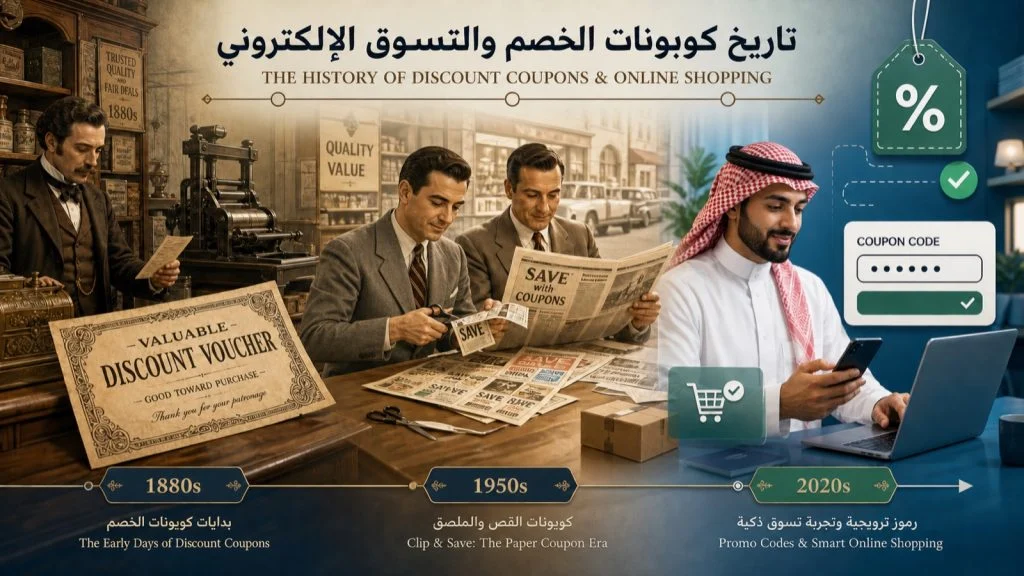
Discover when discount coupons began, how paper vouchers evolved, and why online promo codes became a core part of e-commerce checkout and marketing.
In this guide (13)
- What is a discount coupon?
- When did the first discount coupon appear?
- How did paper coupons become widespread?
- When did coupons move into online shopping?
- From printed voucher to digital promo code
- Why do retailers use promo codes?
- How smartphones changed coupon use
- Promo code, automatic discount, or cashback?
- Discount coupons in Saudi online shopping
- How to use a coupon correctly
- The future of discount codes
- Frequently asked questions
- Sources
The history of discount coupons began more than a century before online shopping. Coca-Cola records using coupons to promote its drink in 1887. The basic idea later moved from a paper voucher presented in a store to a short promo code entered at online checkout. Its purpose remained familiar: encourage trial or purchase while making a marketing campaign easier to measure.
What is a discount coupon?
A discount coupon is a promotional mechanism that gives a shopper a benefit after specified conditions are met. The benefit may be a percentage discount, a fixed amount off, free delivery, a gift, or a later reward. Coupons began as printed vouchers; in e-commerce they are often letter-and-number codes or offers activated automatically through a link.
That is why terms such as coupon, voucher, discount code, and promo code often describe related ideas, even though the redemption method may differ. Our guide to using two promo codes at once explains how modern stores control these rules.
When did the first discount coupon appear?
Coca-Cola’s official history says coupons were first used to promote the drink in 1887. The concept solved a practical marketing problem: reduce a consumer’s hesitation about trying an unfamiliar product, then turn that first experience into future demand.
This milestone combined three functions that coupons still perform: attracting a new customer, connecting a benefit to a clear action, and measuring response to a promotion. A modern digital code serves the same purposes, but the retailer can now record redemption, order value, and marketing channel almost immediately.
How did paper coupons become widespread?
As newspapers, magazines, direct mail, and mass retail expanded, printed vouchers became a practical way to bring shoppers into stores. A customer clipped the coupon and presented it at the point of sale, while the advertiser controlled the product, redemption period, and eligible audience. Large-scale printing helped turn coupons from a limited experiment into a familiar savings habit.
Paper vouchers had obvious limitations: they could be lost or expire, and attributing every purchase to its source was difficult. Moving commerce into electronic systems created a natural opportunity to improve the model.
When did coupons move into online shopping?
The shift became visible in the late 1990s as online stores, shopping carts, and electronic checkout pages grew. The U.S. Census Bureau began collecting monthly retail e-commerce data in October 1999 and estimated that e-commerce represented about 0.6% of retail sales in the fourth quarter of that year. The figure does not identify the first promo code, but it documents the period when online purchasing became measurable retail activity.
Once orders were stored in databases, a retailer could add a “promo code” field and connect each code to programmable conditions: start and end dates, minimum spend, eligible products, redemption limits, or customer groups. The paper voucher had become a rule processed by the store’s checkout system.
From printed voucher to digital promo code
- Printed voucher: clipped from a publication or received by mail and presented in store.
- Printable online coupon: found online but redeemed at a physical shop.
- Promo code: typed into a dedicated field during online checkout.
- Promotional link: opens an offer page or records the source of a visit.
- Personalized offer: attached to an account or loyalty program and may require no code.
Why do retailers use promo codes?
Retailers do not use discounts only to reduce price. A code usually supports a measurable objective: acquire a first-time customer, reactivate an inactive shopper, increase basket value, clear selected inventory, or measure a campaign with a publishing or marketing partner.
This explains why conditions differ. A first-order code may reject an existing account, while a category code may fail when the basket contains an excluded item. If a promotion fails, use our guide to why a promo code is not working.
How smartphones changed coupon use
Smartphones reduced the need to print a voucher or remember it before visiting a shop. A shopper can open an offer, copy a code, and move to an app or checkout page within minutes. Account-linked offers, limited-time alerts, scannable codes, and digital loyalty programs also became common.
Easy distribution created a new problem: expired or audience-restricted codes can continue circulating. Clear eligibility, status, and review information therefore matter. CoboniKsa does not label a code as verified without a real verification date.
Promo code, automatic discount, or cashback?
- Promo code: reduces the checkout price after a code is entered.
- Automatic offer: applies a lower price without requiring a code.
- Cashback: returns value later after its conditions are validated.
- Free shipping: removes delivery cost and may beat a small percentage discount.
The useful comparison is the final total, not the largest number in an advertisement. See our walkthrough for calculating the final price after discount, shipping, and tax.
Discount coupons in Saudi online shopping
Saudi shoppers commonly combine a store name with searches such as “promo code,” “coupon,” “first order,” or “free shipping.” Organizing offers by retailer and explaining eligibility is therefore more helpful than publishing unexplained strings of codes. Browse the CoboniKsa store directory to review available promotions and their conditions.
How to use a coupon correctly
- Read the offer value, audience, and minimum spend.
- Check that the products in your basket are eligible.
- Copy the code exactly without extra spaces.
- Apply it before payment and confirm the total changes.
- Compare the final total with free delivery or an automatic sale price.
The future of discount codes
Coupons are moving from public strings toward more personalized offers: account-linked benefits, selected baskets, limited periods, and loyalty programs. Manually entering a code may become less necessary as retailers automatically apply the best eligible promotion. The original idea will remain, however: give a shopper a clear reason to try or buy while allowing the retailer to measure the outcome.
Frequently asked questions
When were discount coupons first introduced?
Coca-Cola dates its use of promotional coupons to 1887, one of the earliest and best-known documented examples of modern couponing.
When did online promo codes begin?
They spread gradually as e-commerce and online checkout grew in the late 1990s and early 2000s. There is no universally agreed date for one first digital code.
Are coupons and promo codes the same?
Their purpose is similar, but a coupon can be printed or digital, while a promo code is usually a string entered during checkout.
Why do promo codes expire?
A retailer ties a code to a campaign budget, period, audience, and conditions, then disables it when the campaign ends.
Sources
This guide uses the official Coca-Cola historical record and the U.S. Census Bureau record on early retail e-commerce measurement. Information was reviewed on August 12, 2026.