Coupon or cashback? Learn the final-price rule, real examples from noon, Namshi, Sporter, Abdul Samad Al Qurashi, Huawei and Nazih, why codes fail and a pre-checkout plan.
In this guide (13)
- Why is searching for a “discount code” not enough?
- A quick look at search data: what are people looking for?
- What is the difference between a coupon and cashback?
- The final-price rule: the most important saving rule
- Examples from CoboniKsa stores
- Why might a discount code not work?
- A practical plan before every purchase
- When is cashback better than a coupon?
- How to avoid overbuying because of coupons
- The best search terms to use on the site
- How to choose between two stores when there is more than one offer
- Frequently asked questions about saving with coupons and cashback
- Conclusion: saving is a skill, not just a code
Can you really save a noticeable amount when shopping online, or are most coupons just promises that fail at checkout? This question comes up often, especially when a shopper copies a discount code, goes to the cart, and sees a message like: invalid code, this offer does not apply to the selected products, or no coupons available. The problem is not always the code itself; sometimes it is how it is used, the store’s terms, or not understanding the difference between an instant discount and cashback.
In this CoboniKsa guide you will learn a practical way to save with coupons and cashback without confusion. The article does not focus on one store; it gives you a clear system before buying: how to choose the right offer, how to tell whether a code is genuinely useful, when cashback beats a discount, and why a code may not work even if it is listed on the offer page. We use examples from stores on the site such as noon, Namshi, Abdul Samad Al Qurashi, Sporter, Huawei and Nazih, but the main goal is a way of thinking that helps you every time you shop.
Why is searching for a “discount code” not enough?
Many people shop backwards: they choose the product, go to checkout, then quickly search for a code. This sometimes works, but it does not always give you the best saving, because the code is only one part of the final price. You might find 10% off, but shipping makes the final price higher than at another store with no code. Or you might find 10% cashback, which is not an instant discount but a later refund under specific terms. So real saving does not start with the code; it starts with calculating the final price.
To save wisely, ask yourself four questions before paying: does the code work on this product? Is there a minimum order? Is the discount instant or cashback? Is the final price after shipping and tax reasonable? These simple questions stop you falling into the trap of a discount that “looks big” but does not actually lower the cost.
A quick look at search data: what are people looking for?
Monitoring the site’s performance in Google Search Console showed a clear search intent: people are not just searching for the word “coupon”, but for specific solutions such as Sporter discount code, Abdul Samad Al Qurashi coupon, Namshi coupon, and phrases close to the problem of coupons not being available or not accepted. That means articles that explain the problem and give clear steps have a better chance than short articles that only post the code.
This guide is therefore built around practical intent: someone who wants to buy and save, but needs to understand how to confirm an offer is genuine before paying. This kind of content serves both the reader and search engines, because it answers real questions instead of repeating keywords without value.
What is the difference between a coupon and cashback?
A coupon usually lowers the price directly in the cart. If a product costs SAR 300 and the code gives 10%, you should see the discount in the order summary before paying, as long as the product is eligible. Cashback returns part of the purchase value after the order is completed, and may appear later as a credit, reward or refund under the programme’s or store’s terms. So do not treat the two the same way when calculating the price.
A practical example: if you find noon’s 10% cashback offer with code VV100, do not necessarily expect the price to drop at checkout like a normal coupon. Read the offer terms: does the cashback apply to all products? Is there a maximum? Does it need a particular payment method? Does it apply to products from third-party sellers? That way you will not be surprised after ordering.
With a direct discount code such as Namshi code bky15, you are looking for a clear change in the price before paying. If the total does not change, do not complete the order hoping the discount will appear later. With direct coupons, the discount appearing before payment is the most important sign.
The final-price rule: the most important saving rule
The best way to decide is to calculate the final price, not just the discount percentage. The final price means the product price after the discount, plus shipping, tax if any and any extra fees, taking into account the cashback value if the offer is eligible. Sometimes 5% off at a trusted store beats 20% off that does not apply to the product you want. And sometimes free shipping is worth more than a small coupon.
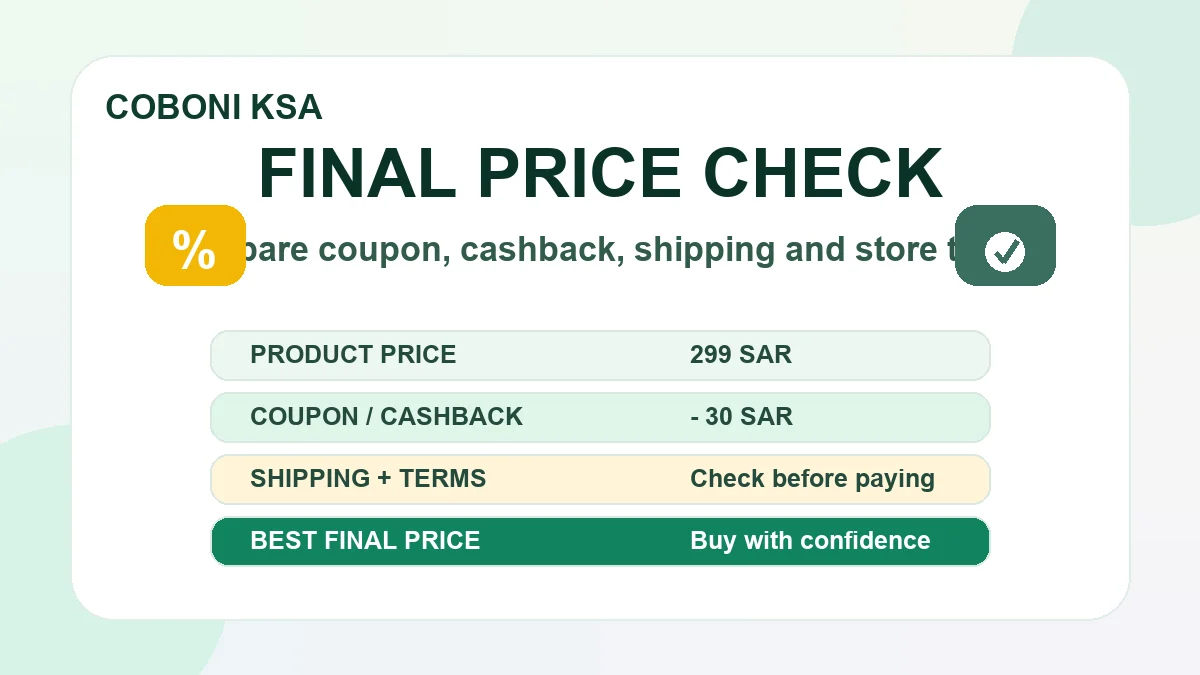
Write this simple formula before buying: final price = product price − discount + shipping + conditions. If the offer is cashback, do not subtract it from the price unless you are sure of its eligibility and how you will receive it. This rule alone can save you from many random decisions. Our discount, cashback and shipping calculator does the maths for you.
Examples from CoboniKsa stores
Let us apply the idea to some stores on the site. On noon, the offer can be 10% cashback with code VV100 on eligible purchases. Focus on the cashback terms, the maximum and how it is calculated. See the noon offer page for details.
At Namshi, the example is different because code bky15 is linked to a discount of up to 20% on eligible products. Here you need to see the discount in the cart before paying. If some products are excluded or already on another offer, the store may not accept the code, or may apply it to only part of the cart. See the Namshi coupon page.
At Abdul Samad Al Qurashi, you can use code ADM72 for a discount on eligible products under the store’s terms. With this kind of store, check the bottle size, perfume type, shipping policy and whether the product is on offer or excluded. With perfume especially, do not let the discount alone be the reason to buy; read the description and confirm the type, size and concentration. See the Abdul Samad Al Qurashi coupon page.
At Sporter, code ST41 gives 10% off under the store’s terms. Because Sporter sells supplements, clothing and sports equipment, discount eligibility can differ between categories. If the code does not work, check the country, the product, the minimum and how the code was entered. Many coupon errors happen because a store or country different from the offer is selected. See the Sporter coupon page.
At Huawei, code ADMT28 is linked to a discount on eligible products. When buying phones or laptops, compare the discount with included gifts, because some offers give accessories, shipping or a warranty worth more than a small discount (see the Huawei coupon page). At Nazih, you can try code ADM47 on eligible products, making sure to check the product category, because personal care and beauty terms can differ by brand or offer (see the Nazih coupon page).
Why might a discount code not work?
A code not working does not always mean the site is unreliable or the offer is fake. There are many common reasons, and most can be spotted before paying. The first is that the offer has ended or its terms have changed. Some stores update campaigns quickly, and a code may stop when the campaign ends or a usage limit is reached. The second is that the code is for a particular product category, such as devices, perfume, supplements or clothing, and does not work on the whole cart.
The third reason is region or country. A code that works in Saudi Arabia may not work in the UAE, and vice versa, so if an offer is written for a particular market, do not use it in another. The fourth is combining offers. Some stores do not allow a coupon on top of an existing sale, or do not allow cashback with a discount code. The fifth is how the code is typed; an extra space before or after it can make the system reject it, especially with codes that mix letters and numbers such as ADM72 or ADMT28. For a full list, read Promo code not working? 9 reasons and fixes.
A practical plan before every purchase
Follow these steps as a small checklist before paying. First, open the store card on CoboniKsa and make sure the offer is up to date. Second, copy the code exactly without changing upper- or lower-case letters. Third, open the store from the link on the card so you do not lose tracking of the offer or cashback. Fourth, add the product to the cart and make sure the country and currency are correct. Fifth, paste the code in the discount box and tap apply. Sixth, watch the final total and do not pay unless the discount appears or the cashback terms are clear.
If the code does not work, do not give up immediately. Remove spaces, try typing the code by hand, check excluded products, then reduce the cart to one product to see whether the problem is a specific item. If the offer is cashback, make sure the order is eligible and that you did not switch to the store through another link after opening the offer link. These details seem small, but they make a real difference.
When is cashback better than a coupon?
Cashback is better when the order value is high, the refund terms are clear and there is no stronger direct discount code. For example, if you have a large noon order and the 10% cashback offer is eligible, the refunded value may be better than a small coupon. But if you need an instant reduction before paying, a direct coupon is better both psychologically and financially because it lowers the amount you pay now.
A simple rule: if the cashback terms are reliable and suit the cart value, include it in your decision. If it is conditional or unclear, treat it as a bonus rather than a main reason to buy. Do not let the promise of cashback push you to buy something you do not need.
How to avoid overbuying because of coupons
The biggest mistake in the world of offers is buying because there is a discount, not because you need the product. A good discount does not mean a good purchase. Before using any coupon, ask yourself: would I buy this product without a discount? Is the price after the discount within my budget? Do I need it now? If the answer is unclear, save the offer and do not rush.
A smart shopper uses a coupon to lower the cost of a decision already made, not to create a new buying decision from scratch. This is especially important during big sale seasons, because the number of discounts can make comparison harder, not easier.
The best search terms to use on the site
To find the right offer quickly, search CoboniKsa by store name or product type. Try terms such as Sporter discount code, Abdul Samad Al Qurashi coupon, noon cashback, Namshi code, Huawei Saudi coupon or Nazih discount code. Using the store name with the offer type helps you reach the right card instead of moving between many pages.
If you are not looking for a specific store, start from the category: perfume, electronics, sports, fashion or general shopping. This is useful because you may find a better offer at a store you had not considered, as long as it suits your actual need.
How to choose between two stores when there is more than one offer
Sometimes you find the same product at several stores, each offering a different type of saving: one gives a discount code, another cashback, and a third faster shipping or easier returns. Do not base your decision only on the number next to the discount. Compare the whole experience: final price, delivery time, return policy, availability of size or colour, seller reliability and whether the offer suits the market you are buying from.
If the purchase is essential and urgent, fast shipping may matter more than small cashback that arrives later. If the product is expensive, cashback may become more useful because its value rises with the order value. If you are buying an easily replaceable product, the priority is the lowest final price. This way the coupon becomes a decision tool, not just a marketing number.
It is also important not to compare an offer that works in Saudi Arabia with one meant for another country. A different country can change the currency, shipping, taxes and even code eligibility. So when using CoboniKsa, focus on stores and offers suited to the Saudi market or clearly marked as valid for Saudi Arabia.
Frequently asked questions about saving with coupons and cashback
Is cashback the same as a discount?
No. A discount usually lowers the price directly in the cart, while cashback returns part of the purchase value later according to the offer terms. So read the details before paying.
Can I use more than one code on the same order?
Usually not. Most stores accept only one code per order. If there is an automatic offer in the cart, the system may not allow another code. See Can you use two promo codes at once?
What should I do if the code shows as invalid?
Check the spelling, country, eligible products, minimum order and offer date. If the discount still does not appear, do not pay on the assumption that it will appear later.
Is it always best to choose the highest discount percentage?
Not always. The best is the lowest final price after shipping and terms. A 5% discount with reasonable shipping may beat a higher discount that does not work on the product you want.
Conclusion: saving is a skill, not just a code
Real saving when shopping online does not depend on copying a code; it depends on understanding the offer and calculating the final price. Use coupons and cashback as smart tools: noon code VV100 is an example of cashback, Namshi code bky15 an example of a direct discount, Abdul Samad Al Qurashi code ADM72 an example of perfume offers, and Sporter code ST41 an example of sports and supplement offers. Every offer has its own terms, and every store applies discounts differently.
Before you press the pay button, take just one minute: check the country, read the terms, try the code, calculate shipping and confirm the final price. That minute can be the difference between an ordinary purchase and a smart one. To make the process faster every time, start from CoboniKsa, search by store name or offer type, then go to the store through the correct link and try the code before completing the order.